Insights · For developers
What 480 off-plan buyers told us about quarterly update films
Off-plan buyers wait two to four years to see what they have bought. Most developers fill the gap with site photos and a paragraph from the project manager. The patterns we see across the Ballymore programmes say that is not enough, and point clearly at what works.
By Sam Hendrick · published 14 May 2026 · 8 min read
Note on the number. The “480” in the title reflects estimated audience reach across the buyer base of two Ballymore developments where Over & Above produces quarterly films. It is not a formal survey. It is the patterns we see in real engagement, real buyer-services call volume and real direct feedback to Ballymore’s customer liaison team. We think the patterns are worth writing down.
The problem nobody is solving
Off-plan buyers commit money to something they cannot yet see or touch. For two to four years, the building is an idea. A render, a brochure, a contract.
Most developers fill that gap with a quarterly email. A handful of site photographs taken on a phone, a construction update written by the project manager, a sentence on weather. The problem is not that the email is short. The problem is that nothing in it builds confidence.
Buyers know the difference between an email and an answer. The email tells them the developer is alive. The answer tells them the building is real, on programme, and being built by competent people. Photographs of foundations and hoardings cannot do that. They are evidence of activity, not of progress.
The volume of “is everything alright” calls into a customer liaison team in the months between updates is the clearest single signal that the comms are not landing. Every one of those calls is a buyer telling you the last update did not answer the question they had.
What buyers actually want
Three things, in order:
- Visibility on what has changed.
- Confidence in the people building it.
- A concrete sense of what their unit will look like.
The third one is the one that gets ignored. Buyers do not want a tour of the showroom. They want to see, on the actual site, where their balcony will be. They want to see the floor their unit sits on. They want to see how their view of the river or the park or the next building over is going to land.
A render does not do that. A render is the marketing image they bought from. They want it composited onto the actual site, the actual floors, the actual progress. That is the trick that quarterly films can do that nothing else can.
Cadence: quarterly, not monthly
Monthly is too often. The build does not change visibly enough month to month for the audience to feel the difference. Buyers stop watching after the second month because nothing new has happened. Quarterly is the cadence the actual progress supports. Three months is enough time for a slab to land, a frame to rise, a facade to start. The film has something to show.
Quarterly is also the cadence that supports the production work. A two-day shoot every three months is a programme a small specialist crew can deliver to a high standard for the duration of a build. Monthly turns into a treadmill that compromises the work.
There is a separate case for monthly aerial monitoring. That is a different deliverable, for a different audience, with a different purpose. It feeds construction directors, not buyers. We treat the two as different products and would recommend any developer working on a long build do the same.
Length: three minutes
We have tested. Three minutes is the right length. Two minutes is too short to land the three things buyers want. Four minutes loses retention. Three minutes lets you cover what has changed, who is on site, where their unit sits, and what comes next, with one moment of quiet for the building to breathe.
Three minutes is also the length that survives forwarding. Buyers do forward these films. They send them to family, to investment partners, to lawyers asking why the completion date moved. A three-minute film gets watched all the way through. A six-minute film does not.
Structure: the four-beat that works
The Ballymore films we make follow a structure that has earned its place across multiple episodes. It is worth writing down because it is the bit most generic property videos get wrong.
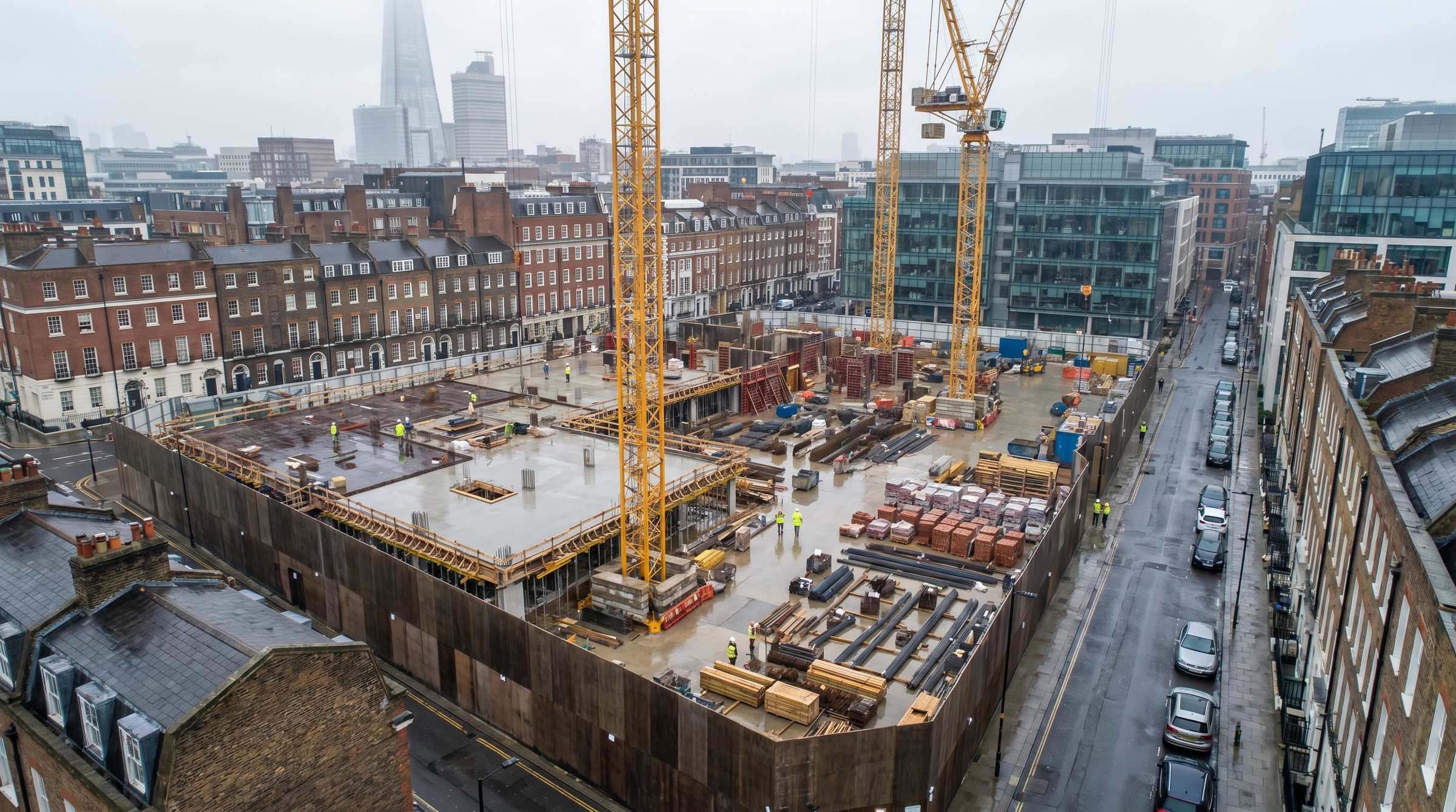
Beat one. Aerial wide of the site, current state. Where is the building. What does it look like today. The buyer has not seen it. Show them.
Beat two. The site team on camera. A site manager, an engineer, a project director. Two or three sentences each. What was completed in the quarter. What is happening this week. Why it matters. The on-camera presence is the entire reason the film works. Photographs and renders are anonymous. People are not.
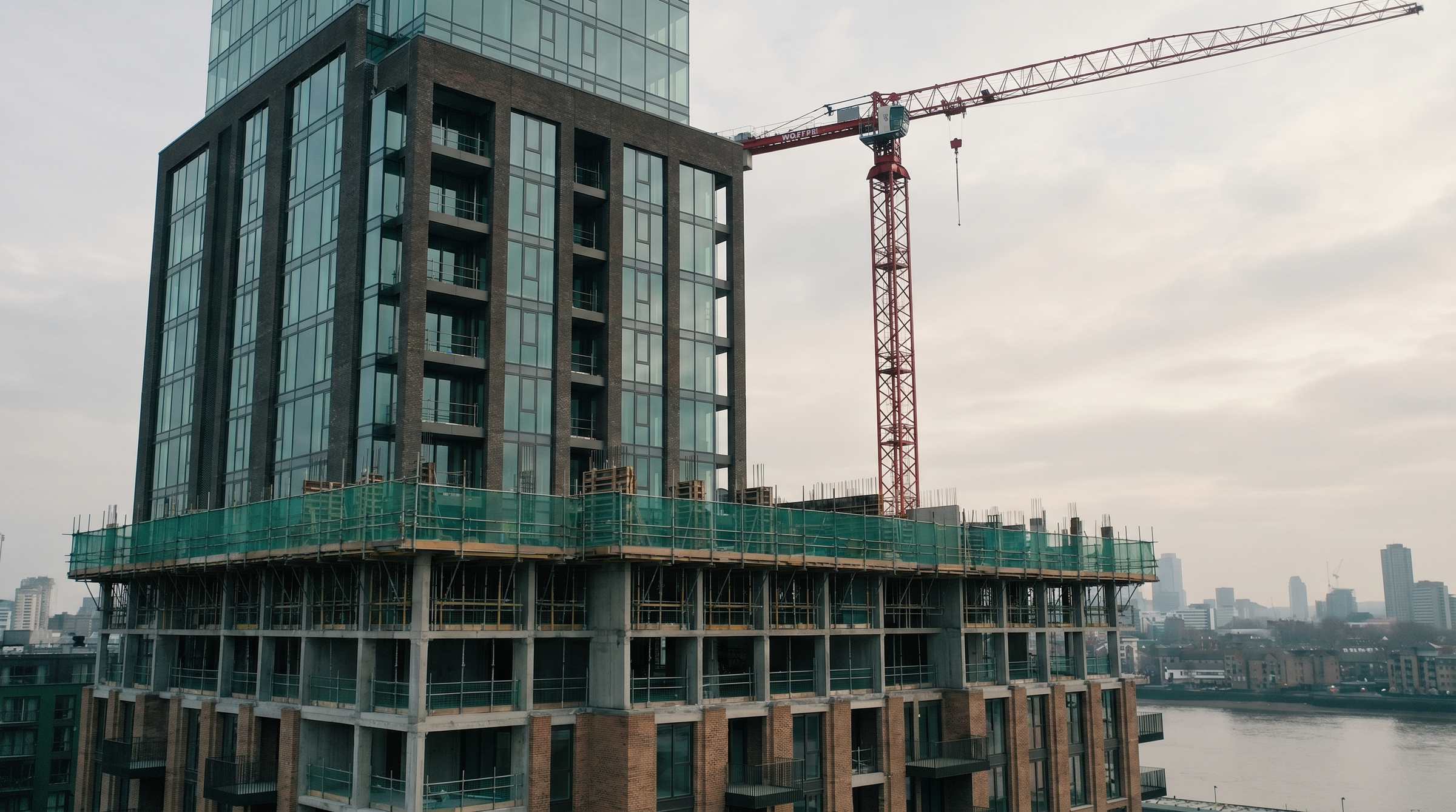
Beat three. The CGI overlay. This is the unique value of a quarterly update film. We composite the architectural render of the finished building into the live aerial of the actual site. The buyer sees, in one frame, the site as it is and the building as it will be. Their floor highlighted. Their view from that floor traced out into the city. No other comms format does this.
Beat four. The look ahead. What the next quarter delivers. The slab, the frame, the facade, the fit-out. Two sentences from the project director. End on the building, not on the team.
The whole thing runs in three minutes. The voice is the developer’s. The visuals are ours.
What to avoid
A few things we have seen developers ask for that do not work, and would recommend against.
Music-led films with no on-camera voices. They look like a brochure. Buyers want to hear from the people doing the work. The film loses its trust function entirely without on-camera presence.
Voiceover by an actor or a corporate narrator. The same problem. If the voice is not the developer’s, the film stops being communication and starts being marketing. Buyers can tell.
Captions over silent footage. A bad compromise. Either commit to a film with sound and presence, or send a written update and a stills pack. The hybrid satisfies neither audience.
Heavy graphics, animated lower-thirds, swooshes. Restraint signals seriousness. The film should look like the developer is competent. Motion graphics signal a marketing video.
Multiple developments compressed into one film. Each development needs its own quarterly. Buyers care about their building, not the rest of the portfolio.
Distribution
The film is sent in the quarterly buyer email, hosted on a private link or the developer’s customer portal. It is also handed to the sales suite, the investor pack, and the board deck. One shoot. One film. Every stakeholder.
Sales teams report measurable drops in call volume in the weeks following a strong quarterly film. The film answers questions before they get asked. That is the primary commercial argument for the format.
What it costs
A standard quarterly buyer update film, ground-only, is around £1,000 per quarter on a two-year retained programme. A premium tier with aerial drone footage and CGI overlay sits around £3,000 per quarter on the same retained structure. Annual cost on a premium programme is £12,000. Set against the cost of a single completion-day complaint or a sales suite that loses confidence in the build, the maths works.
The retained model is the model that works. One-off films cost more per unit, are produced by crews who do not learn the building, and miss the entire point of the format, which is the consistency that compounds across episodes.
What we would recommend, briefly
If you are commissioning quarterly update films for the first time, a short list:
- Quarterly cadence, two-year programme, eight episodes.
- Three minutes per film.
- The four-beat structure above.
- On-camera presence from the site team. Not a voiceover.
- CGI overlay if you have a render and a site to composite it into.
- The same crew across all eight episodes.
- A frame-accurate aerial flight path that turns the eight episodes into a single time-lapse on completion.
The compounding value is the time-lapse. The eight separate films are the deliverable. The time-lapse is the by-product that becomes the most valuable thing in the developer’s archive.
If you are documenting a London development and the current quarterly update is a paragraph and four photographs, a 20-minute call covers the audiences, the cadence, the structure and the cut. We send a written proposal within five working days.
Book a 20-minute call or call 0207 458 4997.